
All the supplies from the conference all in one place
One of the hardest parts about the Wild Wonder Conference is knowing what supplies to get for the classes. I’m going to try to list them all here. I will do my best to keep adding to this page as we go through the conference and get more info. Keep checking back here to stay updated. (this page has some amazon affiliate links to make it easy for you to research supplies, I get a small commission if you use these links but please support small businesses if you can. Some products are not available on Amazon and I have linked the appropriate locations for them.)
Basic Kit for All the Classes
If you have these supplies you will be able to follow along with most classes. I will point out which classes are material specific. First is a basic list then is more info about each.
Writing and Drawing
- Micron Pens/Fineliners
- Brush pens I Use
- Brush pens with bristles
- Mechanical Pencil
- 2B lead (several teachers recommend using this in your mechanical pencil)
- Blackwing Drawing Pencil
Erasers and Whites
- This precise eraser will probably come up in at least one of the classes
- Kneaded eraser for other erasing needs especially more delicate “lifting”
- White gel pen will probably come up in some classes like Jack’s
Sketchbooks
- This is the sketchbook I am using you could also get lighter weight paper for most of the classes such as this (I like spiral bound)
- Cute Sketchbook with Watercolor Paper
- Toned paper sketchbook with 3 colors
Color options (if you had ONE of the options below you could do all the classes)
- Polychromos Colored Pencils
- Watercolor pencils
- Cheap Watercolor Palette with colors
- The John Muir Laws Palette I use (expensive but an investment, custom made so not always in stock)
Brush
- You could do all the classes with this one medium waterbrush.
- If you had a kit with a couple traditional brushes it would help for some classes
Class by Class Supplies
As of Sept 5th I have supplies listed for all the classes that have clear supply needs! If new supply lists come out or are emailed to participants I will try to update here. I’m marathoning all the sessions this year and reporting on them at the end of each day so I will be busy!!! Make sure to see my nightly recaps of each day of the conference on my Youtube channel, every night around 9:30pm California time.
Birch Trees in Watercolor
This class with Sushma Hegde it will help some to have some of the specific brushes. At the very least you will want: several traditional watercolor brushes. She uses the “Silver” brand for everything. Pay attention to sizes and tip shapes.
She recommends something similar to this kit with three brushes Silver Black Velvet Set of size 2, 4, 8
and 12.
She also recommends this Filbert Brush. This is the brush shape that allows you to paint some of her characteristic brush strokes for flowers which might not be as essential for this class on birch trees.
You can probably find cheaper version of these basic brushes.
She recommends this Hahnemuhle Watercolor Book A5
200gsm Portrait but you could use loose sheets of watercolor paper that is 200gsm or a cheaper pad.
Watercolor and Palette
She recommends that you use artist grade watercolors but any brand. She uses Daniel Smith in the colors below. One option is to buy the 5ml tubes of these paints to save money. You have to buy each of these tubes separately at a art store or online because they are not in a kit. Most kits are going to be primary colors and will be frustrating to use.
Her colors with link:
Lemon yellow
New Gamboge
Quinacridone Rose
Pyrrol Scarlet
Sap Green
Peryelene Green
Cerulean Blue
French Ultramarine
Quinacridone Gold
Yellow Ochre
Sepia
She mentioned two palettes on her supply list one is Mijello Airtight 18-Well Palette
The other is from
The palette she actually used in her class ended up being the Mr. Pen- Airtight Watercolor Palette with Lid, Blue, 18 Wells and 2 Mixing Areas.
For painting in the field she mentioned these supplies:
- Stablo field easel
- Art Toolkit Folio Palette (their biggest palette)
Summary: Based on my experience of her classes in the past, having the right materials will have a big impact on how happy you are with your result. If you are ok with improvising and not having something look like the teachers then use what you have. The basic kit I listed above would work. If you actually want to learn her technique at least get traditional brushes, some artist grade watercolor, and proper paper. Instead of getting her exact palette I would actually recommend getting John Muir Law’s custom watercolor palette that will have most of the same colors but you know they are all lightfast and the palette works well in the field. Here is a link to his palette which I have used for over ten years.
Poetry Comics
With Grant Snider
No special supplies needed. Grant used loose 8.5″ by 11″ sheets of 150gsm sketch paper and a brush pen and a pencil. We will be folding paper so if you are a fan of zines get your zine supplies ready.
Understanding Comics book is amazing and he mentioned it.
He also mentions the french artist Jean-Jacques Sempé. Looking to see if there are any publications of him.
Summary: This class is not focused on specific art supplies and the basic kit worked great. Grant was actually using the exact brush pen that I recommended in the basic kit.
Plant Families
Wendy Hollender is a renowned botanical artist that focuses mostly on colored pencils and watercolor pencils so be prepared for that. However, her class is not technique specific so you could do everything with watercolor if that is what you have like me 🙂
- Loose sheets of paper are fine (I will use my main nature journal)
- pen or fineliner
- and a geometric template.

If you fall in love with her style and want to be able to emulate here technique then consider the materials below. Otherwise, don’t worry about all of them.
Here are the supplies that she says she will be using in the demo (you don’t need these apparently):
- Tombow H Graphite Pencil
- She uses the desktop muji sharpener which I couldn’t find but is similar to this one.
- Kneaded eraser
- Tombow Mono round Zero Eraser (if you are detail oriented you will love this eraser!)
- Westcott See – thru ruler
- Pieni Ballpoint Pen
- Micron 05 pen
- Sheet of Duralar Film as Palette (this is where she rubs her watercolorpencils to create a wash)
- Stonehenge Aqua hot pressed watercolor paper
Colored Pencils
- Prismacolor Verithin pencils:*Dark Brown, *Black, *Gray 70% (you can’t buy these individually but here is a pack. They are basically a hard version of the regular prismacolor pencils often used by illustrators for crisp edges)
- Polychromos Pencils (primary and secondary colors)
- More Polychromos Deep Shades
- Dark Sepia 175
- Dark Indigo 157
- Chrome Oxide Green 278
- Red Violet 194
- Olive Green Yellowish 173
- Polychromos Highlights
- Warm Grey IV 273
- White 101
- Ivory 103
- Salmon 130
- Polychromos Earth Tones
- Burnt Ochre 187
- Venetian Red 190
- Light Yellow Ochre 183
- Burnt Sienna 283
- Albrecht Durer Watercolor Pencils
- Cadmium Yellow 107
- Permanent Green Olive 167
- Pale Geranium Lake 121
- Middle Purple Pink 125
- Purple Violet 136
- Dark Sepia 175
- Dark Cadmium Orange 115
- Burnt Sienna 283
- White 101
- Light Yellow Ochre 183
- Warm Gray IV 273
- Earth Green 172
- Ultramarine 120
Summary: It’s a bit hard to prepare for this class honestly. There is some contradictory information and while she says students do not require many supplies she later has multiple lists with copious supplies and each list is different. I have done my best to summarize the information. My suggestion would be to not stress, attend the class with the “basic kit” and if you fall in love with her style start building a collection of the specialized colored pencils, papers, etc that she uses. Be sure to review her attachments before the class or have them ready on your computer to look at. It looks like a fun and in-depth activity that could be hard if you are not prepared.
- You can also see the book she illustrated Foraging and Feasting
- She also mentioned learning botany from the book Botany in a Day
Gesture Sketching with Brush Pens

This class with Charlotte Belland doesn’t have a supply list (yet) but I would recommend two types of brush pens. I will be using these brush pens for most of my note taking and drawing during the conference. https://amzn.to/4nhTLpu They are japanese calligraphy pens but used by many nature journalers.And these ones like this that have actual bristles.
She ended up using these in her class:
- Tombow dual brush pen (water soluble)
- Ecoline dark gray pen
- These look really cool in the earth tones colors! Water soluble.
- Gymboss Interval Timer and Stopwatch she really likes hers
- non precious paper. this is a classic option in a larger format that she suggests for gesture practice.
- Uni Pin Fineliner Drawing Pen (this one she uses in the field and is waterproof.)
- Big Pitt artist pen
“Match the pen size to the paper size” Super useful tip from her.

Summary: A very fun class. The basic kit pens I recommended would work but she suggested several that I have not tried yet. Several of them look very interesting but are also water soluble so not the best combo for watercolor.
Charting Curiosity: Data Visualization Tools
This class is not about supplies so you will probably only need your basic kit (see below). Nevertheless, Gargi is asking that everyone be familiar with the concept of INIWIRMO before the class and watching a video about it from Jack Laws. So do your homework.
“Dear Data” book that Gargi raved about.
Summary: This class is about thinking and organization strategies for your nature journal not specific art supplies. I recommend having the basic kit for sketchnoting and following along.
Keynote by Jennifer Jewell
was inspiring and she mentioned several books that inspired her.
“Local Color” this book is out of print apparently
“Seeing color in the garden” book.
She uses these moleskine journals for her garden journal.
Day Two Classes
Remember, in some cases instructors will post a supplies list last minute. I will try to keep this list updated.
In Merian’s Footsteps: Backyard Expeditions for the curious
This class with Verena Hillgärtner just had a supplies list and resources added to the Sched website. The basic kit covers most of it but I will try to list her supplies here when I get a chance. The only special supplies besides the basic kit are loose sheets of printer paper and a tool to aid with folding (such as bone folder). Plan to have you basic kit supplies mentioned below.
Sketchbook and paper:
- Nostalgie Sketch Book 190g/m², Drawing Notebook, A4
- Same as above but landscape version
- Loose sheets of printer paper (steal them from work or buy them here)
Drawing
- Her Super Cool Purple Lead Mechanical Pencil!!! I had never heard of this before.
- She likes drawing with this really cool colored pencil:
- Pentel Waterbrush Large (this is the same one from the basic kit)
Other tools
- She uses Schmincke watercolors in a limited palette with the following colors
- heliocoelin 479
- quinacridone magenta 369
- lemon yellow 215
- ultramarine 494
- geranium red 341
- chrome yellow 213
- indigo 485
- burnt umber 668
- light ochre 655
- She uses here own custom mini palette with a hexagon pattern for the cells. I was not able to track it down yet.
- Bone Folder Now you can say you have a tool made out of a real bone! This tool helps you fold paper.
- Glue, she doesn’t say what kind but there is a photo of a gluestick on her supply list. Here is an archival one.
Books she mentioned

- Maria Sibylla Merian: Artist, Scientist, Adventurer
- The Girl Who Drew Butterflies: How Maria Merian’s Art Changed Science
Summary: The focus of Verena’s class is not about specific art tools but if you want to try the supplies she uses you have the list here. Her purple pencil and sketchbook in particular look cool as do the books.
After Verena’s class is the keynote. You might be interested in checking out the book written by the speakers before their talk. Your Brain on Art: How the Arts Transform Us
Panel on Nature Journaling Tools
This is a list of basically all the supplies mentioned in this 3 person discussion!
- Roseann Hanson
- Only 5 color palette
- Daniel Smith or Greenleaf Blueberry Colors (handmade)
- Waterbrushes
- She just tried 9 different brands!!!
- Found lots of variation even between same brand
- She now uses this one with multiple configurations!!
- Roseann also uses the main pentel aquash waterbrush large size that so many people use.
- Fumuii Travel Brush Kit that Roseann mentioned
- Travel Kit
- Leather fisherman’s carry bag, metal hook
- Colapsible water bottle
- Tombow mesh bag for wet brushes
- She uses a leather cover and loose 9X6 paper. (modular system that she files the pages later) You can see more about her system and try aspects of it here.
- Sits on pieces of yoga mat
- Kestrel weather station
- Fountain Pen (she uses a fancy one for 35 years but also recommends Fude Demanen)
- Uniball Signo white gel pen
- Only 5 color palette
- Rosalie Haizlett
- Winsor and Newton cotman
- Also sometimes uses Greenleaf and Blueberry Jagged Horizons set
- Her favorite colors that are included in this palette
- Alizarin Crimson
- Yellow Ochre
- Sap green
- Waterbrushes (she was a late adopter due to lack of control of water flow)
- Rest of her kit
- Waxed Cotton Brush Roll from Peg and Awl
- 2 05 Micron pens
- Jewelers loupe
- Tube of white gouache
- clear plastic ruler
- Tiny spiral bound mixed media journal (canson)
- Molotov Paint pens set
- Jane Maday
- Art toolkit palette folio palette
- Favorite colors (Daniel Smith)
- Doesn’t use waterbrushes she uses travel brushes like this affordable kit.
- Handmade carrying case
- mechanical pencil
- 01 or 02 micron
- ruler
- tube of titanium white gouache
- Larger travel kit from Derwent when she wants to carry LOTS of art supplies
- Uses B6 dot journals from archer and olive 160 gsm
- Collapsible water cup
Style Buffet
With Kate Rutter
Kate will be using a lot of different supplies during the class but it is not necessary for you to get them all. Instead she suggests that this class can help you decide what supplies you might want to focus on. She offers a list of options that I will put here but not requirements.
Crisp
- Black waterproof pen with a point tip
- Posca markers, or other markers you use when journaling
- Watercolors and Pentel Waterbrush Large or medium size traditional brush
Delicate
- Fine-point markers, range of sizes: .005, .01, .03, .08; black or sepia
- Fountain Pen (Amazon Basics) w/ Fine point nib, Black ink, not waterproof
- (another option: Lamy Safari w/ Fine point nib)
- Graphite pencils in a range of hardness:
- Blending stump
- Pencil sharpener
- Colored pencils
Juicy
- Black medium-size brush pen
- Black ball-point pen
- Grey marker with point tip (Zebra Midliner is a fave)
- Mechanical pencil, HB or 2B
Spicy
- Some crayons (peeled)
- Ink pad
- Glue stick
- Scotch Tape
- Small knife
- Index cards (3″ x 5″, about 4-6) or scrap paper
Summary: You will get the most out of this class if you do have some art tools to represent each of the categories above.
Adventure Sketching
This class is with Maria Coryell-Martin the founder of Art Toolkit. Definitely check out her Art Toolkit Website These are the supplies she is recommending for the class.
- Platinum desk pen
- With carbon ink (she emphasized using waterproof ink and this is one that works with fountain pens)
- Converter to use waterproof ink in that pen
- Or any waterproof ink pen (this is a zebra fine brush pen)
- This is the pilot brush pen with bristles that she used in the demo
- Journal with at least 90lb/120 gsm weight paper
- Palette such as her art toolkit folio palette
- Pentel Waterbrush medium
- She also mentioned this flat waterbrush
- She briefly mentioned her traditional travel brushes from Rosemary and Co.
- she also mentioned plastic syringe for more easily putting water into waterbrush.
- The following colors from Daniel Smith
- Hansa Yellow Medium
- Quinacridone Rose
- Deep Scarlet
- Cobalt Teal Blue
- Cerulean Blue Chromium
- Pthalo Blue (red Shade) She likes for mixing
- Indanthrone Blue
- Buff Titanium She really likes for mixing
- Yellow Ochre
- Quinacridone Gold
- Burnt Umber
Summary: You could do this class with the basic kit that I described for the whole conference. I will be using the John Muir Laws watercolor palette which contains most of her colors. If you want to try her specific palette or the fountain pen she recommends for fun go ahead but they don’t seem necessary to get the most from the class. Definitely check out the Art Toolkit Website to look at all her cool supplies. She also mentioned the Sketchnote Handbook Book by Mike Rohde
Nature Narratives: How to Create and Engaging Illustrated Essay
This class with Rosalie Haizlett is focused mostly on writing. There is no supply list (yet) so I would bring whatever is your most comfortable kit. If you are new then use the “basic kit” that I mentioned above. The brush pens that I use and microns work fine for writing.
She usually uses a small traditional brush but she is trying to use a larger brush.
she used 9×12 300gsm rough arches watercolor block, even though she said she does not really like that paper
Here is one of Rosalie’s Books: Tiny Worlds of the Appalachian Mountains: An Artist’s Journey
Bee Colorful: The Diverse Beauty of Native Bees
This class with Dr Nina Sokolov is focused on learning how to identify native bee species through drawing the important part of their anatomy. There is not supply list so the basic kit would be good. Brush pens are good for drawing insect anatomy. You might also want to have graphite and eraser ready for this class. A precise eraser like the mono erase would be good. She also mentions color so have either your colored pencil or your watercolor options from the basic kit ready.
Day Three Classes
Sketching Birds in the Field
Instructor Joris de Raedt jorisderaedt.com
- Graphite pencils with varying hardnessess. You might just need 2H, H, HB, 2B
- He mentioned Derwent sketching light wash HB water soluble graphite
- Mechanical pencil
- Pencil sharpener or scalpel
- Kneadable eraser/soft eraser
- Fine eraser like the Mono zero
Paper
- Tracing paper (only for studio work)
- Smooth medium weight paper for graphite sketches
He uses a two sketchbook system in the field starting with- Talens Art Creation 140gr sketchbooks but Moleskine would be similar
- And then more finished drawing in a large A4 Hahnemuhle Cold Press 250gsm,
- He also mentioned Watercolor paper – Arches 9×12 cold press 300g (this is the glued block of paper)
- He also mentioned this arches paper that has a different texture on each side of the paper! Unfortunately it is hard to buy.
Watercolor
- His main colors ( I would recommend getting the Daniel Smith versions of these listed elsewhere on this page: Cadmium Yellow Light Hue, Cadmium Yellow deep, Yellow Ochre, Cadmium Red Light, Alizarin Crimson, Burnt Umber, Ultramarine Blue, Brilliant
- yellow dark, Transparent orange
- Optional: White gouache paints
- Watercolour palette/plastic/metal palette
Compact and nonbreakable, it can be the one attached to your watercolour box - Watercolour Brushes
- Here is a Escoda travel brush size 10 like he uses
- Here is a set of travel brushes that is similar but cheaper
- paper towels
- Jar for water such as this foldable one
Digiscoping: This is when you attach your phone to a scope to take photos or videos. Joris uses this for references for later painting. His scope is also an essential part of his kit but he said you shuld practice drawing birds from life closeup first because managing a scope and drawing through it has a whole learning curve. This stuff can also get VERY expensive.
- This is the phone adapter Swarovski VPA 2 variable phone adapter set
- SPotting scope Swarovski ATX85 scope. You’re going to want to do some serious research and take out a loan before you buy one of these.
- Gitzo tripod GT3531
- with Gitzo head SN/GZ127658
- Binoculars Swarovski CL companion 8×30
- Foldable chair
- Optional: Camera
Drawing Live Owls
Linda Feltner recommends an inexpensive kit for this class, she doesn’t want you to get perfectionist. She suggests loose sheets of newsprint even but I would use the mixed media sketchbook from the basic kit so you have everything together in one spot. She recommends a mechanical pencil similar to the one I mention in the basic kit with 2B lead.
- Mechanical Pencil (she recommends a slightly different model)
- 2B lead
- Basic Mixed Media Sketchbook (spiral bound)
- Newsprint (if you think you will be doing more sketching like this and want really cheap paper it might be worth getting a pad of this)
In addition to the basic supplies that are all you need for the class she also mentions these supplies that she used in some of her art work
Sketching/Drawing
She described a very interesting process in her class using tracing paper and transfer paper.
- She specifically recommends Canson Tracing Paper
- Saral (Wax Free) Transfer Paper. (this is how she transfers the same basic drawing onto various different paper to experiment with different media.)
Papers: She mentioned how she likes to experiment with the same drawing on lots of different paper
- Canson Universal Sketch. 9×12” (22.9×30.5cm). 65lb (96g).
- Strathmore Toned Tan sketch paper. 9×12” (22.9×30.5cm), 80lb (118gsm)
- Arches, hot press 90lb (185gsm)
- Fabriano Artistico Block, Traditional White, hot press, 140lb
(300gsm) - Strathmore Bristol Vellum 500 series, 2-ply.
Watercolor pencils
- Faber-Castell Albrecht Durer (Helio-blue reddish
- Derwent Inktense Pencil(deep indigo)
- Faber-Castell Albrecht Durer (magenta).
Linda mentioned this book that looks very cool called “The unfeathered bird” If you want to understand bird’s bodies underneath the confusing feathers.
Keynote on history of Naturalist’s Notebooks
I’m super excited for this keynote from Roland Allen and have already ordered the book by him so I can skim it in advance. The audio version is fine but you will miss the illustrations.
The Notebook: A history of thinking on paper
Paint Simple Landscapes with Watercolor and Pen
This class with Jane Maday just had supply list added but you could also do it with the basic kit I recommended. She also uses a grid paper watercolor journal which is pretty cool and a relatively new offering. Not required for the class but if you are a journal junkie, you like bullet journaling and watercolor, or if you want to do charts and graphics, or you just like the look of a dot paper then this is pretty cool! Dot paper watercolor journal! Her specific model is actually from www.archerandolive.com
- Pencil and eraser
- Waterproof fineliner pen, size either 1 or 2 Micron Pens
Daniel Smith watercolors:
- Cadmium yellow medium hue
- Raw umber
- Indigo
- Jaynes Gray or Paynes gray
- Cerulean
- Serpentine genuine
- Sap green
- Cascade green
- Titanium white
- Yellow ochre
- White paint pen (optional)
- Hot press watercolor paper: in a journal or in a traditional pad with the glued edges
- Brushes: This is a kit of travel brushes that cover most of the sizes and shapes of brush she mentioned
- She also mentioned this Rake Brush for grass and fur
- A sea sponge (natural sponge) is useful for painting trees
Creative Book Arts for Journaling
This class by Roseann Hanson is one where YOU NEED THE SPECIFIC SUPPLIES.
- Bone folder:
- Waxed linen thread
- curved needles
- Glue brush
- Drawing compass: this is a really cheap one
- Xacto knife
- Ruler
- Single-hole punch
- Thin cardboard (the size of your journal)
- White washi tape
- Assorted art papers and ephemera. You can use stuff lying around or magazines instead of buying these packs.
- PVA glue
- Vellum paper or tracing paper or wax paper from kitchen
- Glassine envelopes:
- White gel pen
- Trailbound Sketches Trail Tiles in collaboration with Hahnemuhle:
- Mini plant press available from Roseann’s shop https://www.exploringoverland.com/shop/p/miniplantpress
- Khadi paper:
- Jute twine: 1.5mm
Summary: You might be able to improvise with the basic kit for the conference but of all the classes this year this is the one where you need special stuff if you want to follow along. If you want to take this class be sure to do your homework and get your supplies lined up. Have empathy for the teacher during the session and try not to ask a million questions during the live class about materials and things covered in the PDF that she has provided.
Butterfly Drawing
This class with Jack Laws does not have a supply list but the basic kit I have outlined should be perfect. You do want to print his butterfly template in advance on stiffer paper if you can. I like printing templates onto 100% cotton resume paper which goes through a printer easy but can take some wet media such as watercolor) Here are some of the supplies I think he will use (I will try to update this after the live class)
- Non photo blue pencil he uses these often for underdrawing
- Watercolor (his palette)
- White goauche at the least, maybe some other colors probably holbein brand
- He always uses these waterbrushes
- White gel pen for highlights
- Bigger white pen
- Colored pencils (he might use some colored pencils especially white)
He mentioned how much he loves the close focus binoculars which are an essential part of many nature journalers kit. Great for bugs, birds, wildflowers. He also mentioned drawing on coquille board which apparently it provides a texture that helps to simulate the pattern on some butterflys. But seems like an obscure supply but can be found here.
Day Four Classes
Tips for Tiny Landscapes
With Leslie Stroz. This was a dangerous class if you like cute and curated art supplies that look expensive! I won’t be able to cover everything that she mentioned but here are some of the main ones.
tiny palette: go draw
blue star crafts: cute tiny carriers and cases
mini sendak canvas supplies roll: by peg and awl
She uses the large Pentel Aquash waterbrush even for her tiny paintings. It is her favorite waterbrush.
One really important tip was she always uses brown ink fineliner pens to draw hew tiny landscapes because it creates a more subtle effect with the watercolor that at that scale black ink lines would ruin.
review of tiny palettes on her youtube: https://www.youtube.com/watch?v=_wPYTlHvqbc
Summary: Good tips for color mixing from limited palette. Her tip about brown ink always for tiny landscapes was also very interesting. Leslie’s approach is very dependent on cute little supplies so if you like that you might want to buy or build your own little supplies. If you try getting the same effect in your normal journal it might not work.
10 Ways to Level up Your Sketching
Vitor Velez (aka the headless sketcher ) is an exceptional artist but also a great teacher that puts a lot thought into conceptualizing and sharing his process. His class is more of a lecture, a masterclass in fact, but not specifically designed to sketch a long. I of course did, and used my basic kit. The following supply list he shared as a reference after the class not as what you need for the class.
- Fineliners
- Micron Pigment Liners – my all-time favorites
- 100% waterproof and smear-proof.
- Excellent for linework, writing, and enhancing edges.
- Sizes he uses:
- 0.03, 0.1, 0.2 – for writing (choice depends on paper type and whether I want text to
blend in or stand out). - 0.1 or 0.2 – for animal line drawings.
Tip: I sometimes use “half-used” Microns with low ink to get a soft grey effect rather than stark black.
- Colored Pencils
- Faber-Castell Polychromos – my go-to set (oil-based, not wax-based)
- Great for fur, feathers, shells, scales, and texture work.
- Pigments hold up well under watercolor washes.
His core color palette includes:- Whites & Greys:
White (101)
Cold Grey II (231)
Cold Grey IV (233)
Payne’s Grey (181)
Warm Grey II (271)
Warm Grey IV (273)
Black (199) - Greens:
Leaf Green (112)
Juniper Green (165)
Grass Green (166)
Olive Green Yellowish (173)
Dark Phthalo Green (264) - Blues:
Phthalo Blue (110)
Ultramarine (120)
Sky Blue (146)
Helioblue Reddish (151)
Dark Indigo (157)
Prussian Blue (246) - Yellows:
Cream (102)
Ivory (103) (this is favorite for blending as well)
CadmiumYellow (107)
Dark Chrome Yellow (109)
Dark Naples Ochre (184) - Browns:
Van Dyke Brown (176)
Brown Ochre (182)
Raw Umber (180)
Burnt Umber (280)
Burnt Siena (283) - Oranges:
Orange Glaze (113)
Terracotta (186)
Burnt Ochre (187) - Reds:
Salmon (130)
Indian Red (192)
Red Violet (194)
Alizarin Crimson (226) - Purples:
Violet (138)
Manganese Violet (160)
- Whites & Greys:
- Faber-Castell Albrecht Dürer – watercolor pencils
- Match Polychromos colors exactly.
- Can be used dry, with water, or by wetting the pencil tip.
- I now use them less frequently, but always keep a few:
White (101)
Black (199)
Cold Grey V (234)
Green Olive (167)
Chromium Green Opaque (174)
Deep Cobalt Green (158)
Caran d’Ache Luminance – wax-based, used sparingly- Colors I rely on:
Blanc White (001) This one he uses for blending other colors
Silver Grey (002) - Perfect for bright highlights and reflections on top of Polychromos layers.
Caran d’Ache Pablo – for deep shadows.- I Keep only two:
Ivory Black (496)
Greyish Black (008).
Prismacolor – softer and waxier, less precise than Polychromos- I keep only two:
Cadmium Orange (PC 118)
Burnt Ochre (PC 943) - Great for boosting vibrancy in orange/brown fur (foxes, tigers).
- As if that was not enough colored pencils he also specifically mentioned Derwent Watercolor pencils in these colors that he really likes
- turquoise green
- water green
Graphite Pencils
Faber-Castell Pitt Matt (2B, 6B, 12B)- Slight sheen makes them great companions to colored pencils.
- Used for pushing contrast or enhancing depth.
Other Tools & Extras
Ceramic Pen Cutter (Slice brand)- To “carve out” details even after layering dark colors.
- Essential for feather highlights, shell textures, micro details.
- White & Black Gouache (Talens)
- Black: for deepening tones.
- White: for whiskers, fur highlights, reflections.
- Paper
Paper is one of the most decisive materials in my process. It not only determines how pencils and
pens behave but also sets the overall feel of the artwork. Over the years, I’ve experimented with a
wide range of papers, and here are my main observations:- Hahnemühle 300gsm Hot-Pressed
- My current favorite for colored pencil and mixed media work.
- Very smooth, making it easier to blend and layer pigments without much effort.
- Compared to Arches, I find it allows me to achieve contrast and volume faster
- Arches 300gsm Hot-Pressed
- A classic, and for many years my main choice.
- The surface has a little more “resistance,” which means I need to blend more and work
harder to achieve deep contrasts when using Polychromos. - Still excellent for building layered, refined textures once you adapt to its character, or if you
use wax-based colored pencils. - Winsor & Newton / Fabriano Hot-Pressed
- Slightly more grainy.
- Because of that texture, I find they don’t respond as well to fine detail work with colored
pencils. - Better suited if you prefer looser, sketchier marks that embrace paper texture.
- Daler Rowney Hot-Pressed (non-cotton)
- More affordable, beginner-friendly option.
- While it doesn’t offer the same richness as 100% cotton papers, it’s surprisingly effective
with both pen and colored pencil. - A good compromise between cost and performance.
Pastelmat - Exceptionally smooth surface, ideal for blending colored pencils beautifully.
- Very forgiving – mistakes can often be “erased” or layered over.
- You can easily create bright reflections using a white pencil or a pen cutter.
- However, it doesn’t take fineliners well, as ink tends to sit on the surface instead of bonding
with the paper. - For that reason, I don’t use it at all, but I still recommend you trying it out as it’s a fantastic
surface to work with.
Summary: This is a masterclass as are his previous classes, learn from his tens of thousands of hours of experience and focus. None of the materials above are needed because it is not designed as a hands on class so don’t buy all of these but use this as a resource to understand his chocies. There is so much detailed information and basically “trade secrets” of his craft that you could mine this class for gems with multiple watchings. Especially if you use colored pencils. For native English speakers especially those from the US this is a good opportunity for you to practice listening and learning from people who have different accents than you. Vitor speaks multiple languages and his English is correct and broad in vocabulary however there are some idiosyncracies about his pronounciation that you might need some time to get used to. The internet connection might have been less than ideal because the recorded version had some lag. Just be patient and pause and relisten if you need.
Gardens and People
with Nishant Jain (aka the sneaky artist)
He mentioned this very cool pen called the Little Fat Man !!! He used brown ink inside it. He uses the one with the bent nib so you can get more line variation with it. I am definitely going to have to try this one.

Supplies he used
- Diatramentis ink brown
- Stabilo earth tone highlighters
- He also uses paint pens a lot in his work such as this set of nature tone posca markers.
- He also sketches directly with colored pencils
- If you like his toned paper work this would be a good small sketchbook for you.
- Sepia toned fineliner
- Derwent inktense pencil
Other supplies mentioned
Summary: He is a minimalist. He tries to only take two or three drawing tools. He does not try to match colors with real life.
Feather Groups
With Jane Kim of @inkdwell She likes Pentel brand in general
- She was using this metal mechanical pencil by Pentel: graphgear with .9 lead
- kneaded eraser she didnt’ have this but kept wishing she did during workshop
- This is the eraser she used during the demo by pentel clickit adjustable eraser similar to this one another option in the mono zero one that many people at the conference recommended.
- She loves the various waterbrushes by Pentel here is a kit with all the types. She even used them for her big mural!!
Garden Journaling
With Bethan Burton from Journaling with Nature
She specifically said to just work with whatever supplies you have on hand.
Here is the link to her really cool garden weather chart!! See below

She also mentioned the book local color which seems like it might be out of print. Might want to look at Ebay, Local library.
Sketchbook: If you are curious, she uses the stillman and birn delta series sketchbook in A4.
Other books she mentioned
- A Wilder Way, How Gardens grow us Poppy Okotcha,
- To stand and stare: how to garden while doing next to nothing
- Why women grow stories of soil, sisterhood and survival Alice Vincent
- Grow your Groceries Simon Akeroyd
Animal Joints and Locomotion
With Chloe Peters has no supply list because she intended it just as a lecture but I found that it is possible and worthwhile to sketch along using graphite and ink.
She mentioned this book: Force: Animal Drawing: Animal Locomotion and Design Concepts for Animators
Nature Journal a River
With Alex Boon. There is no supply list the night before the class but he mentions graphite, fineliner and he usually works with colored pencils.
- Fineliner could be microns
- He likes the Derwent Linemaker in 02 and 01
- Graphite could be this mechanical pencil
- and here is a basic colored pencil set that could work
- He used Derwent Procolor Pencils in the following colors. I could only find this 72 pencils set expensive kit for these pencils but you might be able to buy them individually at your local art store.
- Black
- Burnt Umber
- Sepia Brown
- Bronze
- Payne’s Gray
- Gun metal gray
- olive green
- foliage green
- mars violet
- yellow ochre
- He worked on Bristol board, which is heavyweight but smoother than hot press. He uses this brand which is a bit heavier and fancier.
Summary: The focus of this class is not specific materials. I will be following along with the class but just using my usual sketching supplies and watercolor. You can find his book by the same name and a bunch more on his website: https://alexboonart.com/books/
Journey into the Arctic National Wildlife Refuge
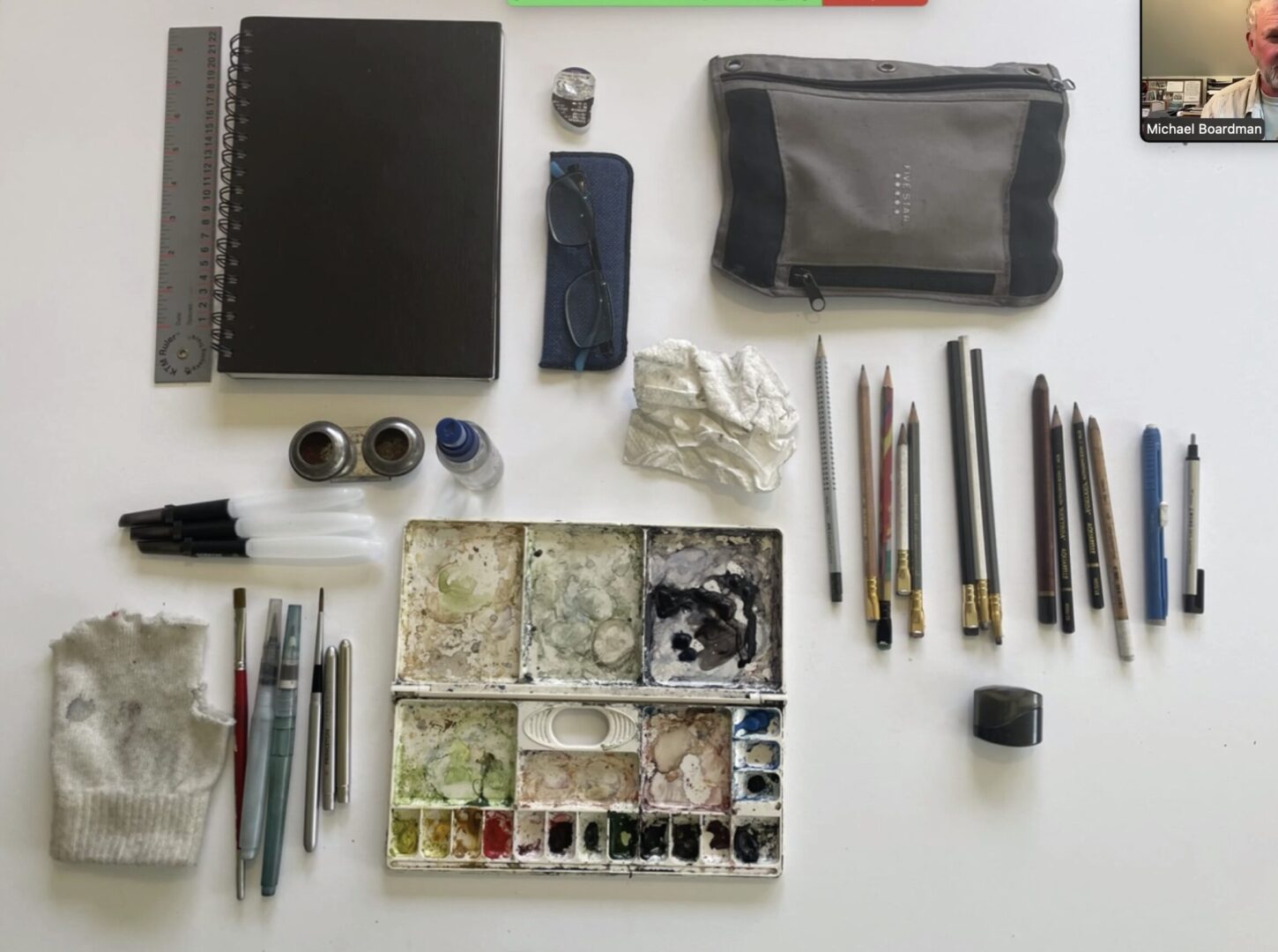
With Michael Boardman. You could use the basic kit for this class but here are the supplies he uses and mentions.
Here are some of the supplies
- sketching pencil or 2 he likes blackwing
- he also uses water soluble graphite pencils
- good eraser he uses a pentel click eraser in the video
- Watercolor kit from Winsor and Newton
- burnt sienna,
- ultramarine blue
- manganese blue hue
- a warm yellow,
- perhaps neutral tint.
- He also brings gray toned paper and draws with white for his mountain drawing
Summary: This class is more of an adventure log with lots of information about doing artist’s residencies. But there are some live sketching parts where you can follow along.
Nature Journaling Botanicals with a 3 Step Approach
With Laura Watson. There is now a list for this class but it is inside the reference guide of the PDF. If you didnt’ have time to see this last minute then you should be able to follow along with the basic watercolor kit I mentioned for the whole conference.
This class goes a bit fast with the demo so if you want to follow along get the materials ready and print the reference in advance You can use these materials
- sketchbook with mixed media or watercolor paper she uses hot press paper
- fine liner permanent such as micron .05, .2, .8
- kneaded eraser
- Basic watercolor palette
- Greens and pinks
- Small brushes, she mentions these cheap watercolor brushes from Meeden
- You could also use a waterbrush like Pentel
- She prefers rubbing graphite on the back. graphitelike this rubbed on the back or transfer paper like this is another option but she says it is more permanent.
Here are all the colors she used in the demo. She seemed very particular about which brand you use for each paint but I just used Quinacridone Magenta, Winsor Violet and other colors from the John Muir Laws Custom palette.
- Holbein
- Quinacridone Magenta
- Light Red
- Manganese Blue Nova
- Neutral tint
- Daniel Smith
- French Ultramarine
- Quinacridone Rose
- Sap Green
You can also check out her amazon shop where she lists a bunch more supplies here.
Summary: This class is not entirely focused on supplies but her method is easier to follow if you have traditional brushes, similar watercolors to hers, and a mixing area.
Monarch Metamorphoses
With Rebekah Lowell has this supply list posted of what she is using but you could do this class with the basic kit I described earlier.
- Prismacolor Verithin in terra cotta (here is a kit of verithin and here is a single terra cota in but the regular prismacolor premier version)
- Micron Pens in sepia
- Beam Paints
- Winsor Newton Watercolors
- Schmincke Travel Palette empty one but i think this is the one she had with the floral color set
- Paintbrushes SNAP, 2, 4 round and filbert
- Global Art Journal with 140 lb cold press watercolor
- White gel pen
Summary: That was the last class of the conference! If you made it this far with the basic kit then you are doing great.
Books
Because there are many authors this year! (be patient as I add these 😉
Your Brain on Art: How the Arts Transform Us This book is by Susan Magsamen and Ivy Ross who are the keynote speakers on day 2. You can learn more about the book on the website here: https://www.yourbrainonart.com/ I’m planning on listening to the audiobook version
The Notebook: A history of thinking on paper Roland Allen will be giving the keynote on day 3 and his book looks amazing! I recommend the print version for this and not the audiobook because it will have lots of images hopefully.
The Joy of Botanical Drawing: A Step-by-Step Guide to Drawing and Painting Flowers, Leaves, Fruit, and More Wendy Hollender has several books on botanical illustration and she will be teaching on day one. Her books look amazing. If you want to develop a very detailed and realistic technique using colored pencils and watercolor pencils these are for you. Or maybe you just want to ogle over the pages, that is fine too.
The Backyard Bird Chronicles Amy Tan is famous for her novels of course but she has published her nature journaling work as well.
Make (Sneaky) Art is a new book by Nishant that is coming out in a week!
John Muir Laws Books including the “bible of nature journaling” :The Laws Guide to Nature Drawing and Journaling
Rosalie Haizlett: Tiny Worlds of the Appalachian Mountains: An Artist’s Journey
Alex Boon How to Draw a River and How to Draw a Tree
Christian Cooper Better Living Through Birding,
Linda Feltner Drawing Nature: The Creative Process of an Artist, Illustrator, and Naturalist
Princeton University Press, 2024. Linda M. Feltner
https://press.princeton.edu/books/hardcover/9780691255385/drawing-nature
Also available on Barnes & Noble, Thrift Books, local bookstores, and Amazon.
Miscellaneous Thoughts
In general I think a sketchbook is better to keep everything together in one place. However, it might be good to have some loose sheets on hand for specific paper types for some classes. For example heavier watercolor paper for Sushma’s class on the first day. You don’t need a whole sketchbook of heavy watercolor paper.
I would make sure I had a mixed media sketchbook like this or whatever you usually journal with. With 150 gsm weight paper you can do watercolor and you can also take notes comfortable. This type of paper will probably be ideal for most of the classes this year. For many years the Stillman and Birn Alpha series with 150gsm 9X12″ wirebound sketchbook was my go-to but they have been having some inconsistencies lately that I am upset about.
If you want to also have some watercolor specific you could get something small with nice paper like this or go to your local art store and buy some sheets of Arches watercolor paper. This type of paper will probably be helpful for a few of the classes this year.
Having some toned paper options might be fun as well. I will have something like this on hand for sure. This sketchbook has 3 colors of toned paper. John Muir Laws, Michael Boardman, and Joris de Raedt, and Gargi Chugh all use toned paper and it could show up in some of their classes. Toned paper would also be helpful for the owls drawing class and the feathers drawing class. Nothing like drawing a white subject on white paper to make you wish you had toned paper! (just make sure you have some white drawing tools as well)
I like graph paper, especially isometric graph paper and I will definitely use some for Gargi’s Data Visualization class. I also use this paper for drawing my art supplies in perspective.

8 Responses
Marley, this is very helpful for me in choosing which classes will be my priority during the conference, since I certainly won’t be able to sit all day!! Many thanks.
Glad it could help KT!
Thanks for this Marley!
You are welcome Hashi! It was a bit of a work of obsession this year!
Hi Marley,
Just as you always do…you covered this!! I will spend days going over this. You did a great job pulling this together. Now that the conference is over I will have time to check materials out, and read all your comments. Thanks so much for what you give back!
Hi Rhonda, thanks for the comment and the accolades. I’m glad I can help in some way. Let me know what you learn from any of the supplies you try or what your experiences are.
This is fantastic! Super helpful. Appreciate the hours you put into this. Many thanks!
Thanks Barbara! Glad it was helpful. It seems like the Wild Wonder Foundation has also realized this is a challenge for people at the conference and did a better job this year of trying to get information out about all the supplies.