The best biography of Leonardo Da Vinci is the one by Walter Isaacson and the best part of that book is the list of Leonardo’s Lessons. In this list, Isaacson shows us that Leonardo was not necessarily a born genius but that there are things he did that we can emulate in our own lives. Here they are paraphrased from the original book (otherwise you would have to read all the way to the end).
- Be curious, relentlessly curious. “I have no special talents,” Einstein once wrote to a friend. “I am just passionately curious.”
- Seek knowledge for its own sake. Not all knowledge needs to be useful. Leonardo did not need to know how heart valves work to paint the Mona Lisa. By allowing himself to be driven by curiosity, he got to explore more horizons and see more connections than anyone else of his era.
- Retain a childlike sense of wonder. At a certain point in life, most of us quit puzzling over everyday phenomena. We might savor the beauty of a blue sky, but we no longer bother to wonder why it is that color. Leonardo did. So did Einstein. We should be careful to never outgrow our wonder years, nor to let our children do so.
- Observe. Leonardo’s greatest skill was his acute ability to observe things. It was the talent that empowered his curiosity, and vice versa. It was not some magical gift but a product of his own effort. When he visited the moats surrounding Sforza Castle, he looked at the four-wing dragonflies and noticed how the wing pairs alternate in motion. This, too, we can emulate.
- Go down rabbit holes. I’ll let you think about that one.
- Respect facts. Leonardo was a forerunner of the age of observational experiments and critical thinking. When he came up with an idea, he devised an experiment to test it. If we want to be more like Leonardo, we have to be fearless about changing our minds based on new information.
- Think visually. Leonardo was not blessed with the ability to formulate math equations or abstractions. So he had to visualize them
- Avoid silos. Leonardo had a free-range mind that merrily wandered across all the disciplines of the arts, sciences, engineering, and humanities.
- Indulge fantasy. His turtle-like tanks? His plan for an ideal city? The man-powered mechanisms to flap a flying machine? Just as Leonardo blurred the lines between science and art, he did so between reality and fantasy.
- Collaborate. Sounds easy right?
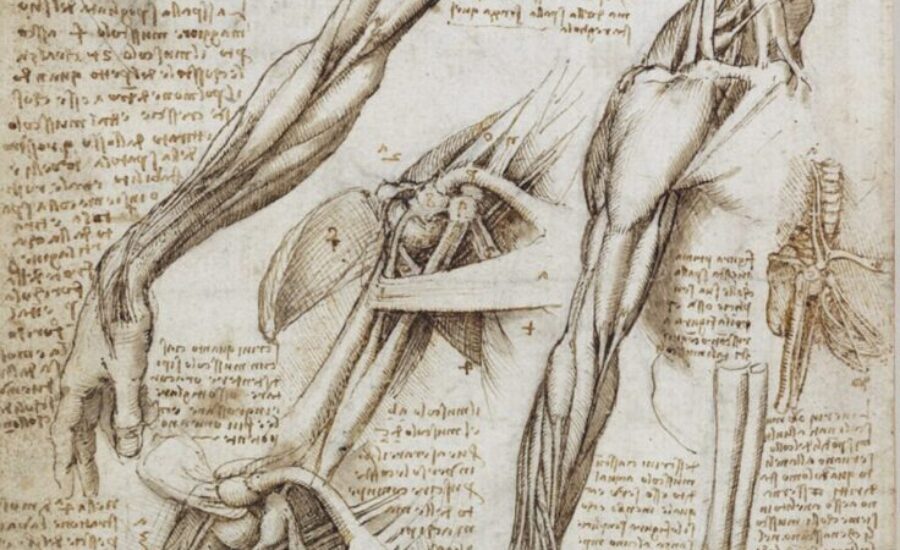
- Take notes, on paper. Five hundred years later, Leonardo’s notebooks are around to astonish and inspire us. Fifty years from now, our own notebooks, if we work up the initiative to start writing them, will be around to astonish and inspire our grandchildren, unlike our tweets and Facebook posts.
- Be open to mystery. One day Leonardo put “Describe the tongue of the woodpecker” on one of his eclectic and oddly inspiring to-do lists. The tongue of a woodpecker can extend more than three times the length of its bill. When not in use, it retracts into the skull and its cartilage-like structure continues past the jaw to wrap around the bird’s head and then curve down to its nostrils. When the bird smashes its beak repeatedly into tree bark, the force exerted on its head is 10 times what would kill a human. But its bizarre tongue and supporting structure act as a cushion, shielding the brain from shock.
Continued Reading
I listened to the audio version of the book and it was very good and convenient for consuming. However, a hardcopy would be better for note taking and for referencing. You can get the book here. I would recommend combining the biography with these two other Leonardo books to help triangulate a perspective on him. The first is called “Leonardo’s Notebooks” and is a beautiful book built around his actual journal pages. This provides a necessary visual balance to the word-based treatments such as Isaacson’s. The other Book I recommend is by scientist Fritjof Capra and it looks at Leonardo Da Vinci’s work from a scientific perspective. It is called “The Science of Leonardo”.
Learn Like Leonardo
Are you feeling inspired by these Lessons from Leonardo? Do you want to practice some of these lessons and apply them to your own life and learning? Check out my class “Journal Like a Genius: 7 Day Leonardo Da Vinci Journaling Challenge” coming out on Skillshare on April 28th 2026. In seven bite size chunks we will practice some of the journaling techniques used by one of the greatest journalers, artists, and creatives of all time. Leonardo Da Vinci’s journaling and sketchbook habit truly made him who he was. In this seven day challenge we will use some of Leonardo’s best ideas and adapt them to our own life and interests.

4 Responses
I see Leonardo in action as you activate your curiosity in this new endeavor. As a fellow creative, Leonardo’s journals have inspired visual outpourings dozens of times. Keep on sharing your genius with the world, Marley.
Hi Teresa! I’m glad that you have also been inspired by Leonardo’s journals. What source have you used for looking at them? One of the published books?
Hey Marley
Guess what!? I moved to Ecuador 🎉
Just a refresher…. I met you at a presentation you did in Borrego a few years back. At the time my husband and I were living in Julian and had no plans to relocate to his birth country, but things have a way of changing (especially politically 😖) and now we are making our home in Vilcabamba although we also have land in the jungle near Zamora. Please let me know if you ever want to visit or if you do a group adventure down here that I could participate in. By the way our land near Zamora is about 100 acres of rain forest and great for sketching excursions. Also my husband is involved with the Vilcabamba hiking group and knows of some great places around here as well. Hope you venture down this way again soon.
All my best,
Jane Santorumn
(Best reached through this email for awhile)
Wow! Congrats on your move. That is exciting. I was in Ecuador in February and would have been there again for several months around July but unfortunately plans changed. I have never been to that part of the country but would love to check it out. Please stay in touch!